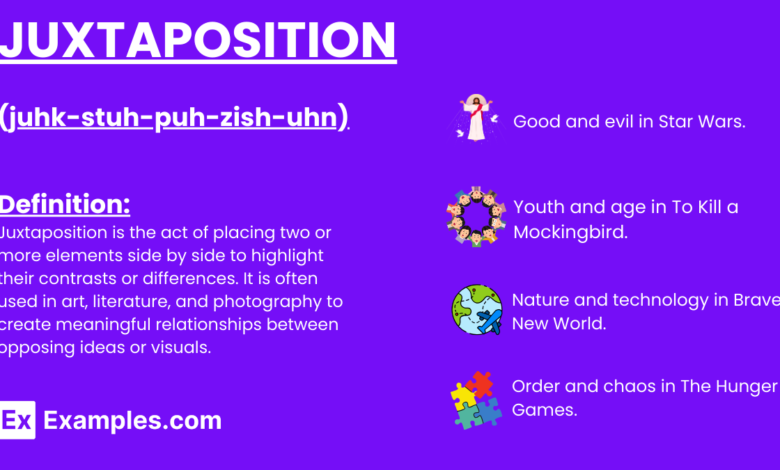
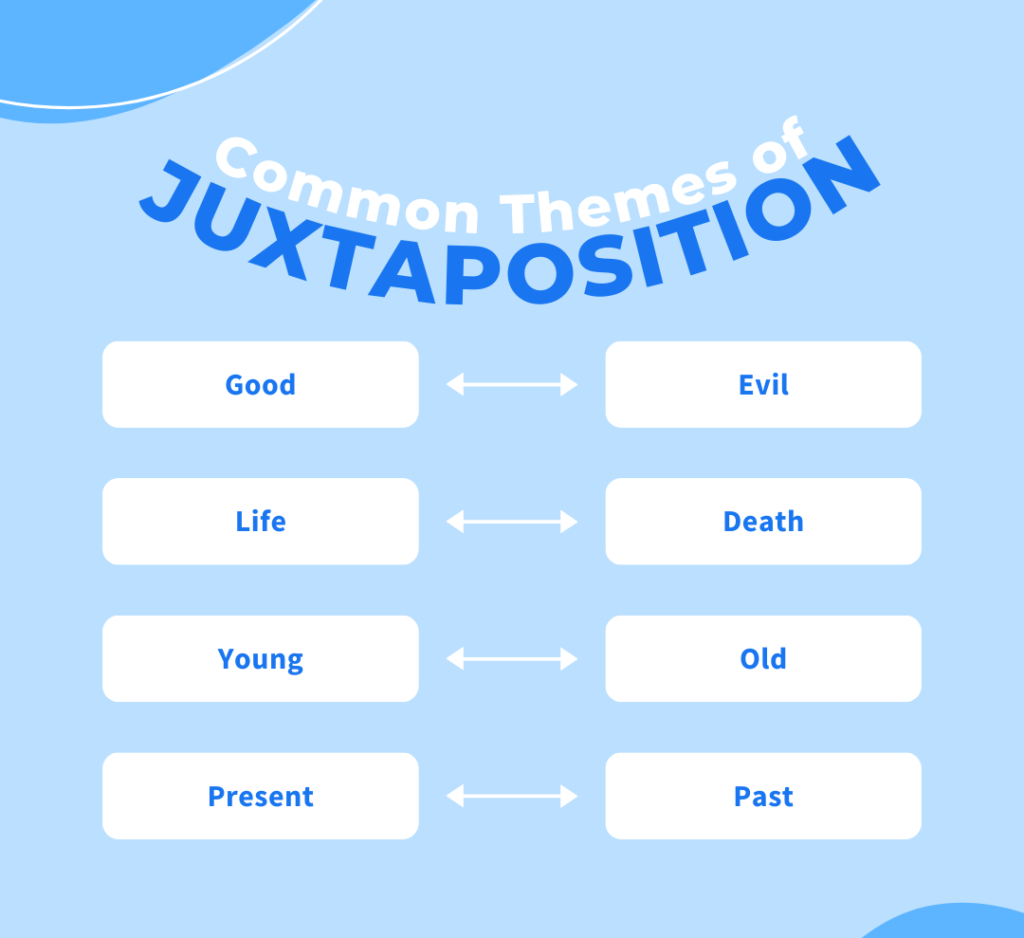
If you’ve ever seen a delicate flower blooming through a crack in a gritty, urban sidewalk, you’ve witnessed juxtaposition in the wild. It’s one of those “fancy” literary terms that sounds like it belongs in a dusty Ivy League lecture hall, but in reality, we use it every single day. Juxtaposition is the act of placing two contrasting elements side-by-side to highlight their differences, create suspense, or reveal a deeper truth that neither element could convey on its own.
Think of it as the ultimate “odd couple” dynamic. When you put a billionaire next to a beggar, or a scene of extreme violence set to a cheerful upbeat pop song, you aren’t just showing two things; you’re forcing the audience to compare them. That comparison creates a spark—an emotional or intellectual reaction that sticks with you far longer than a straightforward description ever would.
In this guide, we’re going to peel back the layers of this technique. We’ll look at how the pros use it in literature, film, and even your favorite advertising campaigns. By the time we’re done, you’ll see juxtaposition everywhere—from the clothes you choose to wear to the way your favorite directors frame a shot. It’s the secret sauce of storytelling, and it’s time we give it the credit it deserves.
Juxtaposition in Classic Literature: More Than Just Words
When it comes to the written word, juxtaposition is a powerhouse tool for character development and world-building. Take Charles Dickens’ famous opening in A Tale of Two Cities: “It was the best of times, it was the worst of times.” By slamming these two extremes together in the very first sentence, Dickens perfectly captures the chaotic, polarized nature of the French Revolution. He doesn’t just tell you things were complicated; he makes you feel the friction of a society pulling itself apart at the seams.
Another heavy hitter is William Shakespeare. The man was a master of the “comic relief” juxtaposition. In his tragedies, he often placed a scene of crude, bumbling humor immediately following a moment of intense grief or horror. In Romeo and Juliet, the bawdy jokes of Mercutio serve to highlight the innocent, almost ethereal nature of Romeo’s pining. By placing the “low” humor next to “high” romance, Shakespeare makes both elements feel more grounded and real. It reminds the audience that even in the midst of grand tragedy, the world keeps spinning in its messy, vulgar way.
But it’s not just about dialogue or plot beats; it’s about the soul of the characters. In The Great Gatsby, F. Scott Fitzgerald juxtaposes the “Old Money” of East Egg with the “New Money” of West Egg. The physical distance across the bay represents a massive social and moral chasm. Gatsby’s garish, desperate parties are juxtaposed against Daisy’s cold, refined boredom. This contrast is what drives the entire narrative, highlighting the emptiness of the American Dream during the Jazz Age. Without that constant comparison, the tragedy of Jay Gatsby wouldn’t hit nearly as hard.
Cinematic Contrast: Why Your Eyes Love Juxtaposition
Film is perhaps the most visceral medium for juxtaposition Examples because it hits you visually and auditorily at the same time. This is often referred to as the “Kuleshov Effect,” a film editing trick where viewers derive more meaning from the interaction of two back-to-back shots than from a single shot in isolation. For example, if you see a shot of a man’s neutral face followed by a bowl of soup, you think he’s hungry. If you see that same face followed by a coffin, you think he’s grieving. The juxtaposition creates the emotion.
Directors like Quentin Tarantino are famous for using “tonal juxtaposition.” Think about the infamous “Stuck in the Middle with You” scene in Reservoir Dogs. You have a horrific scene of torture being carried out to the tune of a lighthearted, catchy 70s folk-rock song. The upbeat tempo of the music contrasts so sharply with the violence on screen that it creates a sense of unease and dark irony. It’s jarring, it’s memorable, and it forces the audience to engage with the scene in a way that a standard “scary” soundtrack never could.
Then there’s the visual juxtaposition of scale and environment. In sci-fi epics like Blade Runner 2049, we often see a tiny, solitary human figure standing against a backdrop of massive, decaying brutalist architecture. This juxtaposition emphasizes the insignificance of the individual in a cold, hyper-industrialized future. By placing the small against the gargantuan, the organic against the synthetic, the director tells a story of isolation without a single line of dialogue. It’s a visual shorthand that speaks directly to our subconscious.
The Power of Juxtaposition in Advertising and Branding
If you think juxtaposition is just for “artists,” think again. Some of the most successful marketing campaigns in history rely on this technique to grab your attention and hold it hostage. The goal of an ad is to stand out, and nothing stands out quite like a contradiction. When a brand takes something familiar and pairs it with something completely unexpected, it creates a “pattern interrupt” in our brains that makes us stop scrolling and start looking.
Take the classic “Mac vs. PC” ads from Apple. They personified the computers as two people: a cool, casual guy in a hoodie and a stuffy, middle-aged man in a suit. By juxtaposing these two archetypes, Apple didn’t need to list technical specifications or processor speeds. They communicated a lifestyle choice through contrast. One was “creative and easy,” the other was “corporate and complicated.” The juxtaposition did all the heavy lifting, making the choice seem obvious to the target audience.
Even luxury brands like Rolex or Porsche use juxtaposition by placing their high-end products in rugged, “unrefined” environments. You might see a $50,000 watch submerged in mud or a sleek sports car tearing through a dusty desert. This contrast reinforces the idea of durability and versatility. It says, “This product is so refined it can handle the most unrefined places on Earth.” It’s a subtle psychological flex that relies entirely on the tension between the elegant object and its harsh surroundings.
Social and Political Juxtaposition: A Tool for Change
On a broader scale, juxtaposition is one of the most effective tools for social commentary and political activism. Satirists and editorial cartoonists live and breathe this stuff. By placing a politician’s extravagant promises next to the harsh reality of their constituents’ lives, they expose hypocrisy in a way that a long-form essay simply can’t. A single image of a luxury high-rise looming over a shanty town tells a complete story about wealth inequality through the simple power of placement.
Street artists like Banksy have built their entire careers on this concept. Banksy often juxtaposes symbols of authority or violence with symbols of innocence and peace—like a rioter throwing a bouquet of flowers instead of a Molotov cocktail, or a child playing with a hula hoop made of a barbed wire fence. These images are powerful because they disrupt our expectations. They force us to reconcile two opposing ideas, usually resulting in a “eureka” moment where we see a social issue from a completely new perspective.
In photojournalism, juxtaposition can be heartbreaking. Some of the most iconic photographs in history involve a single point of peace in a war zone, like a soldier putting a flower in the barrel of a gun. The juxtaposition of the delicate petal against the cold steel of the weapon highlights the absurdity and tragedy of conflict. It’s a silent argument for humanity, made possible only by the presence of two things that should never, under any circumstances, be in the same frame together.
Everyday Juxtaposition: How It Shapes Your Worldview
Once you start looking for it, you’ll realize that juxtaposition isn’t just a technique used by “creatives”—it’s how we make sense of the world. Our brains are essentially giant “contrast machines.” We don’t know what “hot” is without “cold,” and we don’t appreciate “quiet” without “noise.” We constantly define things by what they are not. This internal juxtaposition helps us navigate social situations, aesthetic choices, and even our own personal growth.
In fashion, for instance, the “high-low” trend is a perfect example of juxtaposition. Wearing a designer blazer with distressed, ripped jeans is a deliberate choice to pair the formal with the informal. It creates an effortless, “cool” vibe because the two items shouldn’t technically work together, yet their contrast makes the outfit more interesting than if everything were perfectly matched. It’s about balance—using one element to temper the other.
Ultimately, juxtaposition reminds us that life is rarely a single, flat note. It’s a symphony of contradictions. We are all walking juxtapositions: capable of great kindness and great selfishness, logic and emotion, ambition and laziness. By leaning into these contrasts in our storytelling and our lives, we move away from two-dimensional tropes and toward something that feels authentic. Juxtaposition is the lens that brings the blurred edges of reality into sharp, high-contrast focus.