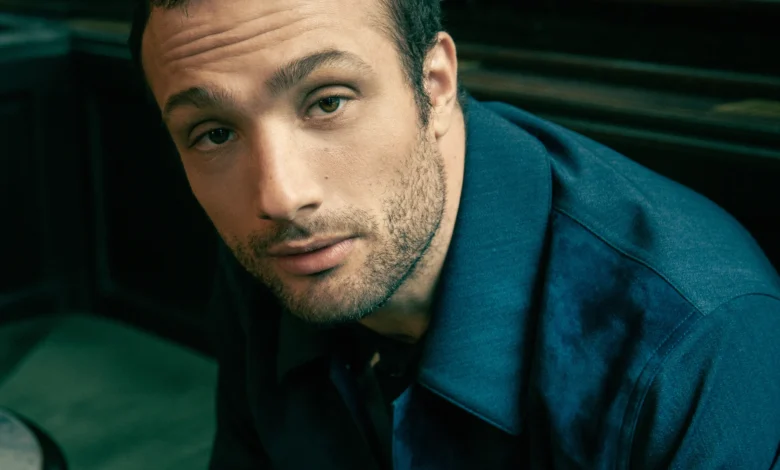
When you look at the career trajectory of Harrison Cosmo Krikoryan-Jarvis, better known as Cosmo Jarvis, you aren’t looking at a standard Hollywood climb. You’re looking at a slow-burn metamorphosis that has redefined what it means to be a modern leading man. For years, Jarvis was the best-kept secret in the British indie scene—a raw, multi-instrumental musician and filmmaker who seemed more interested in the “making” than the “fame.” He first caught the public’s attention not through a blockbuster, but through a quirky, viral folk-pop song called “Gay Pirates,” which showcased a lyrical depth and vulnerability that most pop stars wouldn’t touch with a ten-foot pole.
This early musical phase wasn’t just a side quest; it was the foundation of his artistic DNA. Jarvis spent his early twenties self-producing albums like Is the World Strange or Am I Strange? and directing his own feature film, The Naughty Room. This DIY ethos gave him a level of creative autonomy that most actors lack. By the time he transitioned fully into acting, he wasn’t just another face looking for a script; he was a seasoned storyteller who understood the mechanics of a scene from the inside out. This background is exactly why his performances feel so lived-in and rhythmically distinct compared to his peers.
In recent years, the “secret” of Cosmo Jarvis has finally blown wide open. His transition from the fringes of the UK music scene to the center of massive global productions like FX’s Shōgun represents one of the most successful rebrandings in recent memory. Yet, if you ask the man himself, he’d likely tell you nothing has changed. He remains famously unpretentious, often appearing more comfortable discussing the technicalities of a character’s motivation than the glitz of a red carpet. This groundedness is his superpower, allowing him to inhabit gritty, often broken characters with a level of realism that feels almost uncomfortable to watch.
Breaking the Mold with Gritty Realism and Calm with Horses
The true turning point for Jarvis as a heavyweight actor came with the 2019 film Calm with Horses (released as The Shadow of Violence in the US). In this film, Jarvis played Douglas “Arm” Armstrong, a former boxer turned enforcer for a drug-dealing family in rural Ireland. It was a role that required a terrifying physical presence masked by a heartbreaking, childlike internal struggle. Critics were floored. He didn’t just play a “tough guy”; he portrayed a man caught in a cycle of violence he couldn’t escape, using his expressive, heavy-set features to convey a world of pain without saying a word.
This performance earned him a British Independent Film Award nomination and solidified his reputation as a “transformative” actor. What makes Jarvis so effective in these roles is his refusal to “act” for the camera. He inhabits the space. Whether he’s navigating the brutal landscapes of the Irish underworld or the rigid social structures of a Jane Austen adaptation like Persuasion, he brings a contemporary, visceral energy that bridges the gap between the screen and the audience. He has a way of making period pieces feel urgent and modern, stripped of the stuffy theatricality that often plagues the genre.
Even in his smaller roles, like his brief but haunting turn as Barney in Peaky Blinders, Jarvis leaves a lasting impression. He has this uncanny ability to steal scenes from established veterans simply by existing in the frame with more intensity than everyone else. It’s a quality reminiscent of a young Marlon Brando or Tom Hardy—a “dangerous” unpredictability that keeps the audience on edge. You never quite know if his character is going to explode in rage or collapse in tears, and that tension is what makes his filmography so addictive to follow.
The Shōgun Phenomenon and the Rise of John Blackthorne

Cosmo Jarvis if Calm with Horses was the industry’s wake-up call, then 2024’s Shōgun was the global coronation. Stepping into the shoes of John Blackthorne—a role famously originated by Richard Chamberlain in the 1980s—was no small feat. Jarvis had to navigate a complex narrative set in feudal Japan, playing an English pilot who is essentially a “barbarian” in a highly sophisticated society. His portrayal was a masterclass in cultural friction. He brought a raspy, salt-of-the-earth grit to Blackthorne that made the character’s survival feel genuinely earned, rather than scripted.
Working alongside legends like Hiroyuki Sanada, Jarvis didn’t just hold his own; he created a dynamic that anchored the entire series. His chemistry with Anna Sawai’s Lady Mariko was built on unspoken glances and a shared sense of duty, proving that Jarvis can excel in high-stakes romance just as well as high-stakes violence. The success of Shōgun—which garnered massive viewership and critical acclaim—catapulted him into the “A-list” conversation, yet he handled the press tours with his signature, slightly awkward humility, often deflecting praise toward the writers and his co-stars.
The impact of this role cannot be overstated. It proved that Jarvis could carry a massive, big-budget production on his shoulders while maintaining the integrity of a nuanced character arc. By the time the credits rolled on the first season, audiences weren’t just talking about the stunning visuals or the political intrigue; they were talking about the “Englishman” who managed to be both a fish-out-of-water and a formidable force of nature. It was a career-defining moment that ensured Cosmo Jarvis would be a household name for years to come.
Looking Ahead: The Future of a Multi-Talented Powerhouse
As we move through 2026, the industry is watching Jarvis with bated breath. He has a slate of projects that suggest he has no intention of slowing down or playing it safe. One of the most anticipated is his role in The Alto Knights, a mob drama where he stars alongside Robert De Niro. For any actor, sharing the screen with De Niro is a “make or break” moment, but for Jarvis, it feels like a natural progression. His ability to channel raw, masculine energy makes him a perfect fit for the gritty, Barry Levinson-directed underworld of 1950s New York.
Beyond the mobsters and samurai, Jarvis is also set to portray a young Joseph Stalin in the aptly titled Young Stalin. This is the kind of role that defines an actor’s legacy—a complex, controversial historical figure undergoing a radical transformation. Given Jarvis’s track record with “transformative” roles, expectations are incredibly high. He has the range to capture both the intellectual fervor and the burgeoning ruthlessness required for such a character. It’s a bold choice that highlights his interest in the “gray areas” of the human psyche rather than straightforward hero roles.
Even with his acting schedule packed, the “artist” in Jarvis never truly sleeps. There is always the lingering possibility of a return to music or a shift back into the director’s chair. He remains one of the few figures in entertainment who feels genuinely “indie” at heart, regardless of the size of the paycheck. Whether he’s playing a Navy SEAL in Warfare or a historical tyrant, the common thread is his uncompromising dedication to the truth of the moment. Cosmo Jarvis isn’t just an actor to watch; he’s a creative force that is slowly but surely reshaping the landscape of modern cinema.