The Continental Rivalry: A David and Goliath Narrative
When the schedules align for a Bahrain vs. Australia fixture, the Asian Football Confederation (AFC) holds its collective breath. On paper, it looks like a classic mismatch. Australia, the “Socceroos,” enter the pitch with the pedigree of a nation that has become a fixture at the FIFA World Cup, boasting a roster of players tested in the crucibles of the English Championship, the German Bundesliga, and the Scottish Premiership. Bahrain, conversely, represents the “rising tide” of Middle Eastern football—a team that may lack the household names of their counterparts but more than compensates with a disciplined, “death-by-a-thousand-cuts” tactical approach that has frustrated the continent’s giants for decades.
In 2026, this rivalry has evolved beyond a simple underdog story. It is now a clash of footballing philosophies. Australia brings the “Physicality and Pacing” model—a style rooted in high-intensity pressing, overlapping fullbacks, and a verticality that punishes teams on the counter-attack. Bahrain, meanwhile, is the master of the “Low Block and Transition.” They are a side that is comfortable defending for 80 minutes, maintaining a compact defensive shape that denies space between the lines, only to spring forward with lightning-fast counter-attacks that exploit the space left behind by Australia’s surging wingers.
Expertly speaking, the “Bahrain vs. Australia” dynamic is a test of patience for the Socceroos. Historically, Australia has struggled against teams that refuse to engage in an open, expansive game. When Bahrain plays at home in the humid, electric atmosphere of the Bahrain National Stadium in Riffa, the environmental factors become a “twelfth man.” The heat and the partisan crowd create a pressure cooker that has seen even the most seasoned Australian veterans lose their composure. For the casual observer, it’s a game of football; for the expert, it’s a psychological chess match where the first mistake usually dictates the final result.
Tactical Blueprints: How the Managers Align the Pieces
The success of Bahrain vs. Australia often boils down to the “Midfield Standoff.” Australia traditionally utilizes a 4-3-3 or a 4-2-3-1 formation, looking to dominate possession and use the width of the pitch to stretch the Bahraini defense. Their key is the “Pivot”—the holding midfielder who orchestrates the transition from defense to attack. If Bahrain can disrupt this player’s rhythm through a dedicated man-marking job or a “mid-block” press, the Socceroos’ supply line to their dangerous wide attackers is effectively severed. Australia’s challenge is to find the “Half-Spaces” where their creative midfielders can turn and face the goal.
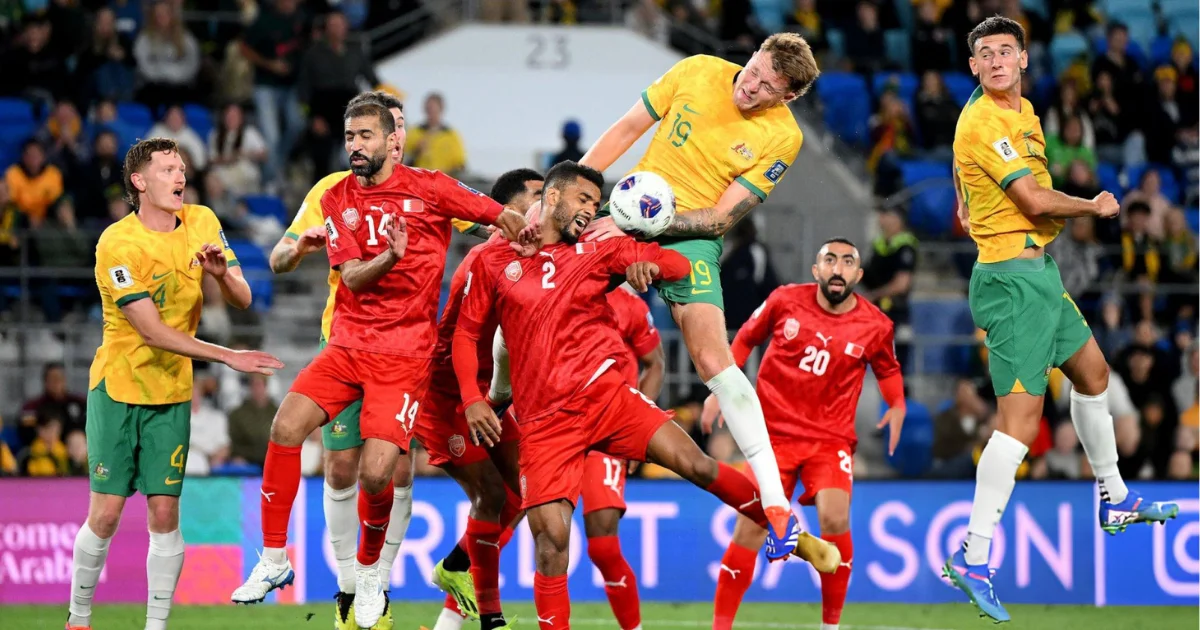
Bahrain’s tactical blueprint is built on “Defensive Cohesion.” They often deploy a rigid 4-4-2 or a 5-4-1, prioritizing a narrow defensive line that forces Australia to play exclusively through the wings. By allowing the Socceroos to have the ball in non-threatening wide areas, Bahrain minimizes the risk of through-balls into the box. The expert take here is that Bahrain “gambles on the cross.” They trust their aerially dominant center-backs to win the headers against Australia’s strikers, betting that they can absorb 20 crosses in exchange for one perfect counter-attacking opportunity.
Furthermore, the “Set-Piece Factor” is where Bahrain often finds their edge. In a game where open-play chances are at a premium, a corner or a free-kick becomes a golden ticket. Bahraini players are notoriously well-drilled in dead-ball situations, using intricate blocking maneuvers to free up their best headers of the ball. Australia, cognizant of this, often plays a more conservative game in their own half to avoid giving away cheap fouls. This “Set-Piece Chess” adds a layer of tension to every whistle, as both teams know that a single delivery into the box could outweigh ninety minutes of tactical dominance.
Historical Context: From the 2006 Qualifiers to Today
To truly appreciate a Bahrain vs. Australia matchup, you have to look at the “Scars of the Past.” The history between these two nations is relatively short but incredibly dense. Australia’s move from Oceania to the AFC in 2006 changed the landscape of Asian football forever, and Bahrain was one of the first nations to feel the impact. Since those early qualifying rounds, the Socceroos have often found Bahrain to be a “Banana Skin” opponent—a team that shouldn’t win on paper but frequently finds a way to secure a draw or a narrow victory that throws Australia’s qualification hopes into a tailspin.
One of the most defining moments in this rivalry occurred in the 2000s when Australia had to fight through a grueling campaign to secure their spot on the world stage. Bahrain proved to be their most difficult hurdle, employing a “Game-Management” style that Australia was not yet accustomed to. The Bahraini players’ ability to draw fouls, slow down the tempo of the game, and frustrate the Australian attackers became a blueprint for other Middle Eastern teams to follow. It forced a tactical evolution in Australian football, leading to a more patient, possession-based approach that we see in the 2026 iteration of the team.
In recent years, the gap has narrowed. While Australia still boasts a higher FIFA ranking, the professionalization of the Bahraini Premier League and the scouting networks in the Gulf region have produced a more “Europeanized” Bahraini squad. Many of their key players now have experience in regional powerhouses or smaller European leagues, meaning they no longer fear the physicality of the Australian squad. This “Closing of the Gap” is what makes the 2026 matchups so unpredictable. The Socceroos can no longer rely on sheer athleticism; they must out-think a Bahrain side that is tactically as astute as any in the AFC.
The Road to 2026: World Cup Implications
As we navigate the qualifying rounds for the 2026 FIFA World Cup, the Bahrain vs. Australia fixtures carry “Six-Pointer” significance. With the expanded World Cup format offering more slots to Asia, the stakes have never been higher. For Australia, a victory over Bahrain is a non-negotiable requirement for direct qualification. For Bahrain, these matches represent an opportunity to leapfrog the established order and secure a historic debut on the world’s biggest stage. Every goal scored in this fixture has a direct impact on the national pride and the sporting infrastructure of both countries.
From a casual expert’s perspective, the “Mental Fortitude” of the teams will be the deciding factor. World Cup qualifiers are marathons, not sprints. A loss in Riffa or a draw in Sydney can create a “Pressure Vortex” that affects the next three games in the schedule. Australia’s coach has the unenviable task of managing a squad that travels thousands of miles across time zones, while Bahrain’s manager must maintain a “High-Alert” defensive discipline for 180 minutes of home-and-away action. It is a grueling test of logistics as much as it is a test of footballing skill.
Ultimately, Bahrain vs. Australia is the quintessential Asian football experience. It’s a mix of raw passion, tactical rigidity, and individual brilliance. It represents the meeting of two very different cultures that have found a common language on the pitch. Whether you are rooting for the Green and Gold or the Red and White, this fixture is a reminder that in the modern game, there are no easy wins. As the 2026 qualifiers reach their crescendo, keep your eyes on the desert—because that’s where the future of Asian football is being written, one tackle and one goal at a time. Let’s go.