The Identity Crisis That Created a Masterpiece
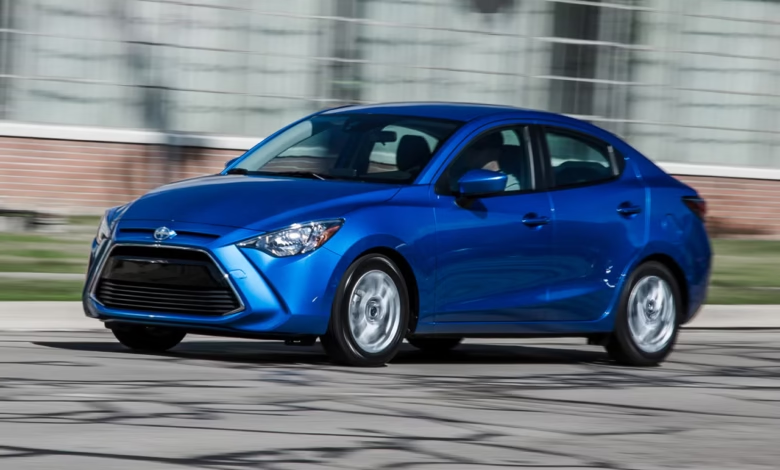
If you follow the automotive industry closely, you know that some of the best cars ever made are the results of “marriages of convenience” between rival manufacturers. The Scion iA is the poster child for this phenomenon. Launched in 2016, it arrived during the twilight years of Toyota’s youth-oriented Scion brand. On the outside, it wore a Scion badge and a somewhat polarizing “gaping maw” front grille, but underneath that skin, it was 100% Mazda. Specifically, it was a rebadged Mazda2 sedan, a car that Mazda decided not to sell under its own name in the United States. This weird corporate hand-off resulted in one of the most mechanically over-engineered subcompact cars to ever hit the American market.
At the time, the subcompact segment was a bit of a wasteland, filled with “econoboxes” that felt like they were made of recycled soda cans and powered by lawnmower engines. The Scion iA changed that narrative instantly. Because it was developed by Mazda—a company obsessed with driving dynamics and “Jinba Ittai” (the feeling of oneness between horse and rider)—the iA didn’t drive like a cheap car. It had a sophisticated suspension setup, a rigid chassis, and steering that actually communicated what the front tires were doing. It was a budget car for people who actually enjoyed the act of driving, which was a revolutionary concept for a vehicle with a starting price under $17,000.
The identity crisis didn’t stop at the badge, though. When Toyota eventually shuttered the Scion brand in late 2016, the iA didn’t disappear; it was rebranded as the Toyota Yaris iA and later simply the Toyota Yaris Sedan. This means the car has lived three different lives under three different names, yet its cult following remains strongest under the original Scion banner. For enthusiasts and used-car hunters in 2026, the Scion iA represents a “secret” entry point into Mazda’s legendary engineering, wrapped in the bulletproof reliability and service network of Toyota. It is the ultimate automotive “hack” for anyone who wants a premium driving experience without the premium price tag.
Under the Hood: Efficiency Meets Engagement

When you pop the hood of a Scion iA, you aren’t going to find a fire-breathing monster, but you will find a remarkably clever piece of engineering. It features a 1.5-liter SkyActiv four-cylinder engine producing 106 horsepower and 103 lb-ft of torque. In a world of 700-horsepower electric SUVs, those numbers might sound modest, but you have to consider the math. The iA weighs only about 2,400 pounds. This high power-to-weight ratio, combined with Mazda’s high-compression engine technology, makes the car feel punchy and responsive in city traffic. It’s a car that rewards you for using all of the tachometer, humming along with a refined zing rather than a coarse drone.
The real magic, however, lies in the transmission options. Most budget cars of this era were saddled with mushy Continuously Variable Transmissions (CVTs) that drained the life out of the driving experience. The Scion iA bucked the trend by offering a crisp, short-throw six-speed manual transmission as standard equipment. This gearbox is widely considered one of the best “teacher” manuals ever made—it’s forgiving for beginners but mechanical enough to satisfy a pro. Even the optional six-speed automatic was a “real” geared transmission with a lock-up clutch, providing direct shifts and a “Sport” mode that actually felt, well, sporty.
Beyond the fun factor, the iA was a pioneer in efficiency. In an era before hybridization was the norm for every small car, the iA was pulling down an EPA-rated 42 MPG on the highway with the automatic transmission. This wasn’t just “laboratory” math; real-world drivers consistently reported hitting those numbers with ease. The engine utilizes a direct-injection system and an ultra-high compression ratio of 12.0:1, which allows it to extract every possible Joule of energy from a drop of regular 87-octane gasoline. It remains one of the smartest choices for commuters who want to dodge high fuel prices in 2026 without the complexity or weight of a massive battery pack.
Interior Sophistication: The “Premium” Budget Cabin
If the exterior of the Scion iA was a bit quirky, the interior was an absolute revelation. Step inside, and you’d swear you were sitting in a vehicle that cost $10,000 more. Because Mazda designed the cockpit, the ergonomics are flawless. The dashboard features soft-touch materials, circular air vents that feel sturdy rather than flimsy, and a tablet-style infotainment screen that was lightyears ahead of what Toyota or Honda were offering in their entry-level cars at the time. There’s a distinct lack of the “hard, scratchy plastic” that usually defines the subcompact segment, replaced instead by blue contrast stitching and metallic accents.
The infotainment system, known as the Mazda Connect system (though branded as Scion’s system), utilized a rotary controller on the center console. This is a feature usually reserved for German luxury brands like BMW or Audi. It allowed the driver to navigate menus without taking their eyes off the road, a massive safety and usability win. Furthermore, the iA came “monospec,” meaning there were no confusing trim levels. Every single iA came standard with a 7-inch touchscreen, a rearview camera, keyless entry with push-button start, and even a low-speed pre-collision safety system. In 2016, finding an automatic braking system in a subcompact car was virtually unheard of.
The seats deserve their own paragraph. While most small cars offer flat, unsupportive chairs that lead to backaches on long trips, the iA features deeply bolstered sport seats that hold you in place during spirited cornering. They are upholstered in a high-quality, durable fabric that has proven to hold up remarkably well over a decade of use. Even the steering wheel, which tilts and telescopes, feels right in your hands, wrapped in a material that mimics leather without the maintenance headaches. It’s a cabin that makes you feel like you’ve “made it,” even if you’re still working your way up the corporate ladder.
The Ownership Experience: Reliability and Longevity in 2026
As we look at the Scion iA from the vantage point of 2026, its reputation for reliability has only grown. Because it uses a naturally aspirated engine (no turbos to fail) and a traditional geared transmission, the mechanical “simplicity” has paid off in spades. Many iA owners are now crossing the 150,000 and 200,000-mile marks with nothing more than basic oil changes and brake pads. The Mazda-built SkyActiv engine is famous for its timing chain (rather than a belt) and its robust cooling system, making it one of the most durable small-displacement engines of the modern era.
Maintenance is another area where the iA shines. Since it was sold through the Toyota network, parts are incredibly easy to find and relatively inexpensive. Whether you need an air filter or a suspension bushing, you can walk into any Toyota dealership or local auto parts store and get what you need. Furthermore, because the car is so light, it’s remarkably easy on its “consumables.” Tires last longer, brake rotors don’t warp as easily, and the suspension components aren’t stressed by the massive weight typical of modern SUVs. It is a “low-stress” car that doesn’t demand much from your wallet once you’ve driven it off the lot.
Finally, there is the “fun factor” that keeps these cars on the road. The Scion iA is a car that people genuinely love. It has a personality that is missing from modern, over-automated vehicles. In 2026, as more cars become “appliances” on wheels, the mechanical honesty of the iA—the way the steering weights up in a corner, the click of the gear shifter, and the eager growl of the engine—makes it a future classic. It’s the perfect car for a teenager’s first ride, a city dweller’s daily commuter, or even an enthusiast’s “gas-sipping” weekend project. The Scion iA may have had an identity crisis at birth, but it has aged into an absolute legend of the subcompact world.