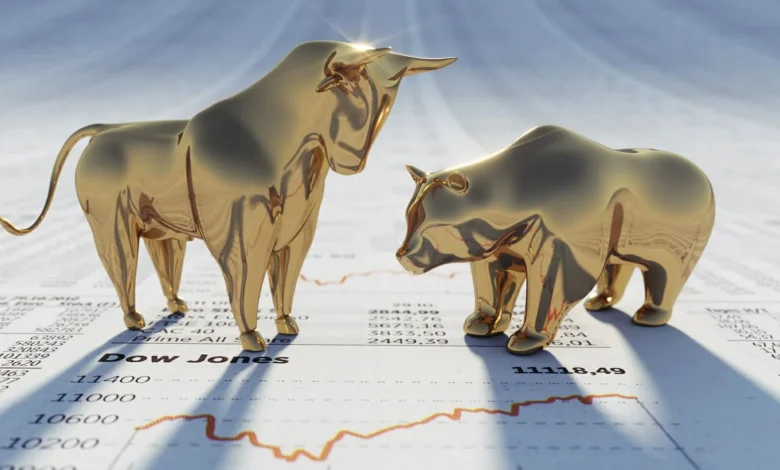
The Grand Old Index: What Exactly is the DJIA?
If you’ve ever tuned into a news broadcast or glanced at a financial app, you’ve seen those three or four-digit numbers flashing in red or green. Usually, the first thing people mention is the DJIA, or the Dow Jones Industrial Average. Founded by Charles Dow and Edward Jones back in 1896, it is the oldest continuing US market index. But don’t let its age fool you; in 2026, it remains one of the most cited barometers of the American economy. While newer indices like the S&P 500 or the Nasdaq Composite might track more companies, “The Dow” holds a special place in the psychological landscape of the investing world.
At its core, the DJIA is a price-weighted index of 30 “blue-chip” companies. These aren’t just any businesses; they are the titans of industry, the household names that dominate their respective sectors. Think Apple, Microsoft, Disney, and Coca-Cola. To be included in the Dow is a badge of honor, signifying that a company is a leader in the US economy and possesses a massive market capitalization. Because it only tracks 30 stocks, it isn’t necessarily a perfect reflection of the entire market, but it is an excellent snapshot of the health of the biggest players on the field.
Expertly speaking, the DJIA functions as a “price-weighted” average, which is a bit of an anomaly in a world dominated by market-cap weighting. This means that stocks with a higher price per share have a greater influence on the index’s daily movement than those with lower prices. While critics argue this is an outdated way to measure value, proponents suggest it provides a unique perspective on industrial momentum. In 2026, despite the rise of complex algorithmic trading, the Dow remains the “everyman’s” index—the one your grandfather tracked and the one that still moves the needle on the evening news.
The Price-Weighting Puzzle: How the Dow Moves
To really understand the DJIA, you have to wrap your head around the “Dow Divisor.” Since the index is price-weighted, you can’t just add up the prices of 30 stocks and divide by 30. Over the decades, stock splits, spinoffs, and changes in the constituent companies have made a simple average impossible. Instead, the total sum of the 30 stock prices is divided by a constantly adjusted number known as the Divisor. As of 2026, this number is a tiny fraction, meaning that a $1 move in any single Dow stock can move the entire index by several points.
This mathematical quirk creates some interesting dynamics. For instance, a 1% move in a high-priced stock like UnitedHealth Group will have a much larger impact on the DJIA than a 1% move in a lower-priced stock like Verizon. This is why investors often look at the “points” gained or lost rather than just the percentage. If the Dow is “up 400 points,” it’s often due to a few heavy hitters in the tech or healthcare sectors having a particularly strong morning. It’s a specialized way of looking at market sentiment that prioritizes the “price power” of individual firms.
From an expert’s vantage point, the DJIA is less about diversification and more about “representative leadership.” The Selection Committee (yes, there is a literal committee that decides who stays and who goes) looks for companies with excellent reputations, sustained growth, and interest to a large number of investors. They don’t change the lineup often, which gives the Dow a sense of stability. When a company is removed—like the high-profile exit of Intel in favor of Nvidia back in late 2024—it marks a fundamental shift in how we define “Industrial” in the 21st century.
The 2026 Context: The Dow in a Post-AI Economy
As we navigate the financial waters of 2026, the DJIA has undergone a quiet transformation. The word “Industrial” in the name is almost a misnomer now; the index is dominated by technology, financial services, and healthcare. We are seeing the “AI-driven” rally of the mid-2020s fully integrated into the Dow’s movement. Companies that have successfully pivoted to include automated intelligence in their core operations are the ones currently propping up the index. The Dow is no longer just about steel and steam; it’s about silicon and software.
One of the biggest factors affecting the DJIA today is the Federal Reserve’s “higher-for-longer” interest rate stance. Because the Dow is made up of established, dividend-paying giants, it is sensitive to the cost of borrowing and the yield on government bonds. When rates are high, “Team Red” often sees a dip as investors move toward safer fixed-income assets. However, because these 30 companies have massive cash reserves and “fortress balance sheets,” the Dow often proves more resilient during market volatility than the more speculative tech-heavy indices.
Expertly speaking, the 2026 Dow is also reflecting a shift toward “Sustainable Industrialism.” The committee has placed a higher emphasis on companies that lead in ESG (Environmental, Social, and Governance) metrics, recognizing that modern “blue-chip” status requires more than just a profit—it requires a sustainable business model. This has led to a slight “greening” of the index, as legacy energy companies face stiffer competition for their spots from renewable energy leaders. The Dow isn’t just a number; it’s a reflection of our changing social and economic values.
The Retail Investor’s Guide: Trading the Dow
For the casual investor in 2026, you don’t actually “buy” the DJIA. You can’t call up a broker and ask for one share of the index. Instead, most people access the Dow through ETFs (Exchange-Traded Funds) like the DIA, affectionately known as the “Diamonds.” These funds hold the 30 stocks in the exact proportions required to mirror the index’s performance. It’s one of the most popular ways to get broad exposure to the “winners” of the US economy without having to pick individual winners and losers yourself.
Trading the Dow requires a different mindset than trading individual stocks. Because it is a concentrated index, it is highly susceptible to “sector rotation.” If there’s bad news in the banking sector, the Dow might suffer disproportionately because financials make up a significant portion of the weighting. Conversely, in times of economic uncertainty, investors often “flight to quality,” pouring money into the Dow’s 30 stocks because they are perceived as “too big to fail.” This makes the DJIA a favorite for conservative “buy and hold” investors who want steady growth and reliable dividends.
However, the 2026 landscape has also introduced “Micro-Dow” futures and leveraged options that allow for high-speed speculation on the index’s movement. Expert traders use these tools to hedge their portfolios against sudden market shocks. Because the Dow is so liquid—meaning there are always buyers and sellers—you can enter and exit positions in seconds. Whether you are using it as a long-term retirement vehicle or a short-term tactical tool, the DJIA remains the most versatile instrument in the investor’s toolkit. It’s the “Gold Standard” of market metrics for a reason.
Future Horizons: Where is the Dow Heading?
Looking toward the late 2020s, the DJIA is poised to break through psychological barriers that seemed impossible just a decade ago. As global trade becomes more digitized and US-based multinationals continue to expand their footprint in emerging markets, the Dow’s earnings power is only growing. We are likely to see further shifts in the 30-stock lineup as “Legacy Tech” gives way to “Quantum” and “Biotech” leaders. The Dow’s ability to reinvent itself while maintaining its core identity is its greatest strength.
The expert consensus for the next few years is focused on “Earnings Quality.” In a world where valuations can sometimes get detached from reality, the Dow remains anchored by actual, profitable companies. While a “dot-com” style bubble might pop in the broader tech sector, the Dow 30 are the companies that actually have the revenue to back up their stock prices. This makes the DJIA the “safety net” of the American financial system. It tells us not just what people are betting on, but what people are actually buying.
Ultimately, the DJIA is a story about the American Dream. It’s a record of how a small group of industrial companies grew into a global economic force. As we move through 2026, the Dow continues to be the most reliable, transparent, and recognizable measure of financial success. It’s been through world wars, depressions, and pandemics, and it’s still standing. Whether the number is 40,000 or 50,000, the Dow Jones Industrial Average remains the heartbeat of Wall Street, and its rhythm is stronger than ever. Let’s go.