The Silent Handshake: Why Car Logos Define the Brand
When you’re walking down a busy city street or stuck in a Monday morning traffic jam, your eyes naturally gravitate toward the silver, gold, and colorful emblems gracing the grilles of the vehicles around you. To the casual observer, these are just “car logos,” but to a branding expert or a true gearhead, they are complex vessels of history, psychology, and corporate ambition. A car logo is arguably the most hard-working piece of graphic design in the world. It has to look equally prestigious on a massive dealership pylon, a tiny key fob, and a steering wheel airbag cover, all while enduring extreme weather and high-speed vibrations for decades.
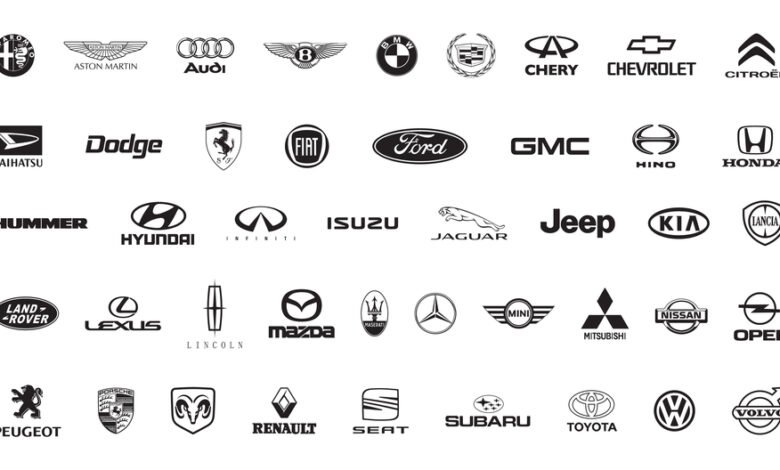
The psychology behind these symbols is fascinatingly deep. Think about the “Three-Pointed Star” of Mercedes-Benz. It isn’t just a pretty geometric shape; it was originally designed to represent the brand’s dominance over land, sea, and air. When a consumer looks at that logo, they aren’t just seeing a car brand; they are subconsciously registering “prestige,” “engineering excellence,” and “German heritage.” Automotive designers spend thousands of hours debating the exact radius of a curve or the specific “sheen” of a chrome finish because they know that the logo is the handshake between the machine and the human. It is the first thing you see when you approach the car and the last thing you see as it pulls away.
Furthermore, car logos act as tribal markers in our modern society. Whether you realize it or not, the badge on your hood says something about your values. A Subaru “Pleiades” star cluster suggests an outdoorsy, practical nature; a Ferrari “Prancing Horse” screams uncompromising performance and Italian passion; a Tesla “T” signals a tech-forward, eco-conscious mindset. These symbols create instant communities. We live in an era where people will get tattoos of their favorite car logos or engage in heated internet debates about which emblem holds the most “soul.” Understanding car logos is, in many ways, understanding the visual shorthand of 20th and 21st-century culture.
The Heraldry of the Highway: Stories Behind the Icons

If we peel back the layers of some of the world’s most famous car logos, we find stories that are often stranger than fiction. Take the BMW “roundel,” for instance. For years, the popular myth was that the blue and white quadrants represented a spinning aircraft propeller against a blue sky—a nod to BMW’s history as an aero-engine manufacturer. While that’s a great story, the truth is a bit more grounded: the colors are simply the national colors of the Free State of Bavaria, where the company was born. However, the “propeller” myth became so ingrained in car culture that BMW eventually embraced it in their marketing, proving that sometimes the legend is more powerful than the fact.
Then there is the mystery of the Alfa Romeo logo, which is perhaps the most complex and “metal” emblem in the automotive world. On the left, you have a red cross on a white field, the symbol of Milan. But on the right, you have the “Biscione”—a giant green snake wearing a crown and, quite literally, eating a human being. This heraldic symbol belonged to the House of Visconti, the historic rulers of Milan. It is a bold, aggressive, and ancient piece of art that perfectly encapsulates the fierce competitive spirit of Italian racing. It tells you that this isn’t just a transportation device; it is a mechanical beast with a pedigree that stretches back centuries.
We also have to look at the “hidden” geometry in logos like Toyota. To the untrained eye, it looks like a stylized letter “T” made of three ovals. But the expert perspective reveals that those three overlapping ovals represent the heart of the customer, the heart of the product, and the ever-expanding technological progress of the company. Even cooler is the fact that if you look closely at the logo, you can actually trace out every single letter of the word “T-O-Y-O-T-A” within the emblem itself. This kind of “Easter egg” design is what makes car logos such a rich field of study for designers. They are masterpieces of minimalism, packing an entire corporate philosophy into a few square inches of molded plastic or metal.
Evolution and the “Flat Design” Revolution
If you’ve looked at new car releases lately, you might have noticed a major shift in the world of car logos. Major players like Volkswagen, Nissan, BMW, and Kia have all recently ditched their 3D, “skeuomorphic” chrome badges in favor of flat, 2D, minimalist designs. This isn’t just a random fashion trend; it’s a calculated response to the digital age. In 2026, a car logo spends more time being viewed on a high-resolution smartphone screen or a digital dashboard than it does on a physical radiator grille. A 3D logo with complex shadows and gradients looks “muddy” and dated in a digital interface, whereas a clean, flat vector logo looks crisp and modern.
This “de-branding” or “simplification” movement hasn’t been without controversy. When Kia revealed its new, futuristic, connected-script logo, thousands of people took to Google to search for “Who makes the KN car?” because the stylized “IA” looks remarkably like an “N.” While this might seem like a design failure, others argue it’s a brilliant move. It generated massive conversation and signaled that the brand had moved so far away from its “budget” roots that people didn’t even recognize it as the same company. It was a visual declaration of a new era of electric and autonomous vehicles, proving that a logo change can be a powerful tool for repositioning a brand’s entire identity.
But why the sudden obsession with “minimalism” across the board? Beyond digital clarity, it’s about “future-proofing.” As we move toward a world of electric vehicles (EVs), many of the traditional design cues of car logos—like being centered on a functional radiator grille—are becoming obsolete. EVs don’t need big grilles for cooling, so designers are now using logos as light-up elements or integrating them into smooth, aerodynamic “frunks.” By simplifying the logo to its most basic geometric form, brands make it easier to animate, illuminate, and adapt to the sleek, sci-fi aesthetic of the 2026 automotive landscape. The logo is no longer just a badge; it’s a digital signature.
The Future of the Badge: Illumination and Identity
As we steer further into the late 2020s, the physical car logo is undergoing its most radical transformation since the invention of the hood ornament. We are entering the era of the “active” logo. Thanks to advancements in LED and OLED technology, many new vehicles feature illuminated badges that “breathe” or pulse with light when the owner approaches with a digital key. These glowing emblems serve a dual purpose: they provide a “welcome sequence” that makes the car feel alive, and they act as a high-tech beacon for brand recognition in the dark. A glowing Rolls-Royce “Spirit of Ecstasy” or a lit-up Mercedes star is the ultimate 21st-century status symbol.
Furthermore, as autonomous driving technology becomes more prevalent, the car logo might take on a new functional role. There are concepts currently being tested where the logo changes color or pattern to communicate with pedestrians. For example, a logo might glow turquoise to signal that the car is in “Self-Driving Mode” and has “seen” the person waiting to cross the street. In this scenario, the logo moves from being a static symbol of ownership to a dynamic communication tool. It becomes the “eyes” of the vehicle, bridging the gap between the artificial intelligence inside the car and the humans outside of it.
Despite all this high-tech evolution, the core purpose of car logos remains the same: to tell a story. Whether it’s a heritage brand like Cadillac subtly updating its “wreath and crest” to look sleeker, or a new EV startup like Rivian using a compass-inspired logo to signal adventure, these symbols are the anchors of the automotive world. They are the tiny details that we obsess over, the chrome-plated promises of quality, speed, and status. As long as humans are driving (or being driven by) machines, we will continue to look to that central badge on the hood to tell us exactly who we are and where we are going. The car logo is, and always will be, the crown jewel of industrial design.